Best Coffee for Homemade Lattes: Beans, Milk & Recipes (No Espresso Machine Needed)

A great homemade latte starts with the coffee, not the milk. You need a strong, full-flavored base that can stand up to three or four parts of milk without disappearing — and you do not need an espresso machine to make one. A moka pot, a French press, or even a strong drip brew can give you a latte base that tastes like the café version.
The Quick Answer
The best coffee for a homemade latte is a medium to medium-dark roast with a naturally sweet, chocolatey or nutty character — the kind that stays present under milk instead of fading into it. Brew it strong, about twice your normal strength, and pair it with whole milk (or oat milk, if you prefer dairy-free) heated to about 150°F. A latte is roughly one part strong coffee to three or four parts milk.
| Hot Latte | Iced Latte | |
|---|---|---|
| Coffee base | Double shot of espresso, or about 2 oz of strong brewed coffee | Double shot of espresso, or about 2 oz of strong brewed coffee, cooled |
| Milk | About 6–8 oz steamed milk | About 6–8 oz cold milk over ice |
| Ratio | About 1 part coffee to 3–4 parts milk | About 1 part coffee to 3–4 parts milk |
| Best milk | Whole milk (richest foam); oat milk is the closest dairy-free option | Whole milk or oat milk; both pour cleanly over ice |
| Caffeine (roughly) | About 120–150 mg from a double shot | About 120–150 mg from a double shot |
What Makes a Coffee Good for Lattes?
Milk is a flavor muffler: it softens acidity, rounds off sharp edges, and dilutes whatever the coffee brings — which is why a delicate, lightly roasted coffee can vanish completely under it. A latte coffee needs enough body to survive the milk and enough sweetness to taste like something once the milk does its work.
That is why medium and medium-dark roasts are the usual latte pick. They carry the chocolate, caramel, and nutty notes that pair naturally with milk, and their lower acidity means the milk does not have to fight the coffee. Very light roasts, with their bright, tea-like acidity, tend to taste thin and sour in a latte — wonderful in a pour over, where nothing stands between you and the cup, but milk is not their friend.
The other half of the equation is strength. A latte is mostly milk, so the coffee portion has to be concentrated. Espresso is the classic base because it is the strongest common brew — about 18 grams of coffee turned into roughly 36 grams of liquid, a 1:2 ratio, in 25 to 30 seconds. If you are brewing without an espresso machine, you need to imitate that concentration, not a normal cup of drip coffee.
The Best Roasts and Origins for Lattes
For a latte, reach for a medium or medium-dark roast first: medium roasts are balanced and sweet, medium-dark roasts are bolder with more chocolate and caramel character, and both hold up under milk far better than a light roast. Our guide to roast levels covers the full range.
Origins matter too, in a general way. Brazilian coffees are a classic latte choice — they tend toward chocolate, nut, and low acidity, which is almost a recipe for a good milk drink. Colombian coffees are another strong pick: balanced, sweet, and smooth, with enough body to stay present. Our Colombia vs Brazil comparison and our Brazil Santos flavor profile go deeper on both.
What about flavored coffee in a latte? It is one of the easiest wins in home lattes. A flavored bean does the work a café would do with syrup, with no extra step. Our French Vanilla Coffee is a small-batch roasted coffee with rich, creamy vanilla flavor and smooth, well-rounded notes — steamed with milk, it makes a vanilla latte without any syrup. Our Pumpkin Spice Coffee is flavored with pumpkin, cinnamon, and nutmeg (no clove), and its warm spice notes hold up under steamed milk, all year round. Both work hot or iced.
No Espresso Machine? Three Ways to Make a Latte Base
An espresso machine is the easiest way to make a latte base, but it is far from the only way. Any of these three methods will give you a strong enough base — the key is brewing about twice as strong as you would for a normal cup.
1. Moka Pot
The moka pot is the closest thing to espresso without the machine. It pushes hot water through finely ground coffee using steam pressure, producing a strong, rich brew. It is not true espresso — a moka pot works at a fraction of espresso's roughly 9 bars of pressure — but for a latte, the difference barely matters once the milk goes in. Use a fine grind and about 2 ounces per drink. Our moka pot brewing guide covers the technique in full.
2. French Press Concentrate
Brew your French press at about double strength: roughly twice the coffee you would normally use for the same amount of water. Steep for 4 minutes as usual, then press. The result is a strong, full-bodied base that stands up to milk. This is also the simplest method if you already own a French press — no new equipment, just more coffee in the same brewer. Our French press guide covers grind and timing.
3. Strong Drip or Pour Over
This is the weakest option, but it works in a pinch. Brew at about double strength — twice the coffee for the same water — and use a smaller serving of the result as your base. A normal-strength cup diluted with three parts milk will taste mostly like warm milk, so do not skip the doubling step.
The Milk: What to Use and How to Heat It
Whole milk is the default latte milk for a reason: its fat and protein make the richest, most stable foam, and its natural sweetness rounds out the coffee. If you drink dairy-free, oat milk is the closest substitute — it steams and foams more like whole milk than almond or soy milk, and its mild, slightly sweet flavor does not fight the coffee. Almond milk foams poorly and can taste thin; soy milk works but can curdle if the coffee is very hot, so pour the milk first and the coffee second if you use it.
For a hot latte, heat the milk to about 150°F (about 65°C) — hot enough to be comforting, cool enough that the milk's sweetness survives. Much hotter than about 160°F and the milk starts to taste cooked and flat. A simple handheld milk frother, a French press plunger pumped up and down, or a jar shaken hard and microwaved for 20 to 30 seconds will all make foam; none of them needs a steam wand.
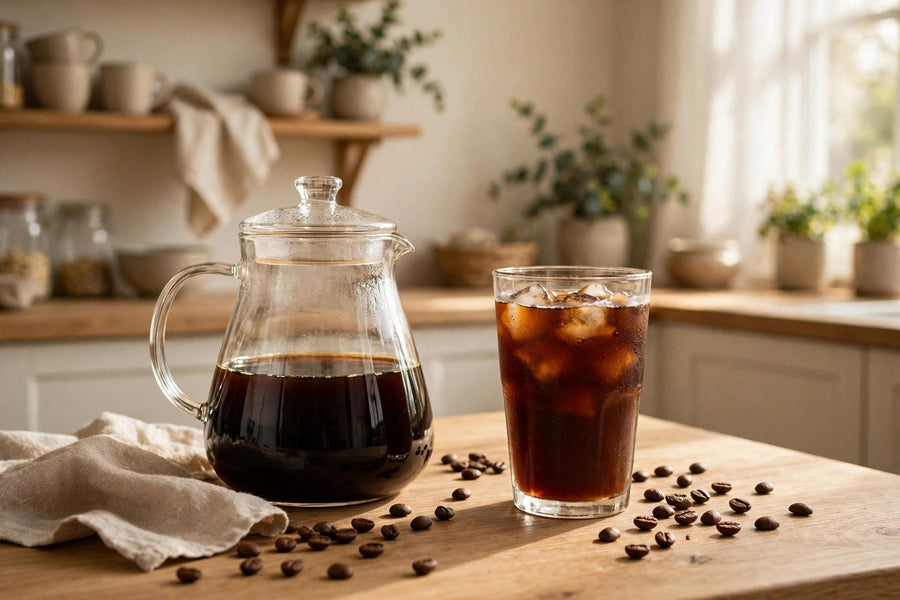
For an iced latte, skip the heating entirely: pour cold milk over ice, then add your coffee base. Cold brew concentrate makes an excellent iced latte base — it is already strong and already cold. Our concentrate vs ready-to-drink guide explains the roughly 1:8 concentrate ratio and the roughly 1:1 dilution; with milk as the diluent, one part concentrate to one part milk over ice is a good starting point.
How to Make a Hot Latte, Step by Step
Start with your coffee base: a double shot of espresso, or about 2 ounces of strong coffee from a moka pot or French press concentrate, poured into a wide mug.
Heat about 6 to 8 ounces of milk to about 150°F and froth it until it has roughly doubled in volume with a layer of fine, glossy foam on top. Pour the milk into the coffee in a slow, steady stream, holding back the foam with a spoon until the end, then spoon the foam on top. The classic ratio is about one part coffee to three or four parts milk; if the drink tastes weak, use less milk or a stronger base next time, not more coffee in the same cup.
How to Make an Iced Latte
Fill a tall glass with ice, pour in about 6 to 8 ounces of cold milk, then add about 2 ounces of your coffee base. Pour the coffee last so it layers over the milk, then stir. If you brew your base hot, let it cool for a few minutes first; pouring hot coffee straight over ice melts it fast and waters the drink down.
Caffeine in a Latte
A latte made with a double shot of espresso carries roughly 120 to 150 milligrams of caffeine — about the same as a normal 8-ounce cup of drip coffee, which lands around 95 milligrams, or a little more. The milk adds no caffeine, so a latte's caffeine depends entirely on the coffee base: one shot is roughly 60 to 75 milligrams, two shots roughly double that. Our caffeine guide by brew method has the full breakdown.
Common Homemade Latte Mistakes
The most common mistake is a weak base. If your latte tastes like warm milk, the coffee was not strong enough — double the coffee, or switch to a moka pot or French press concentrate. The second mistake is overheated milk: past about 160°F, milk loses its sweetness and tastes flat. The third is the wrong grind for your method — a coarse grind in a moka pot under-extracts and tastes sour and thin, while a fine grind in a French press slips through the filter and turns the cup gritty. Our grind size chart matches each method to its grind.
Buying Coffee for Lattes From Supreme Sip
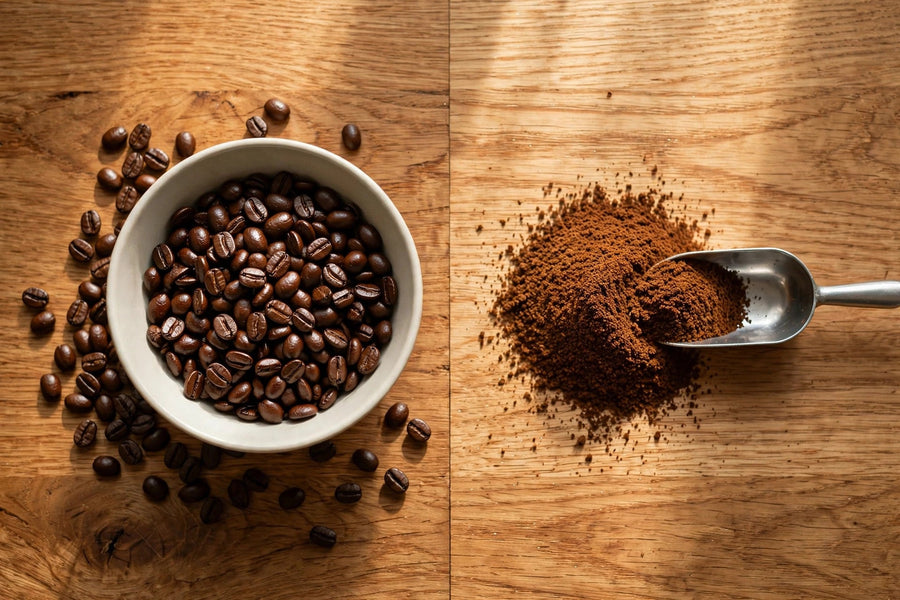
Our coffees are roasted the day they ship, and every coffee comes in four grinds: Whole Bean, Standard, Espresso, and Coarse. For latte brewing, order Whole Bean and grind it fine just before you brew, or order the Espresso grind and it arrives ready to use.
Flavored coffee starts at $25.99 — check each product page for current bag sizes, grind options, and pricing, or browse our flavored coffee collection. For more, see our light vs medium vs dark roast guide and our espresso vs drip coffee guide.
The Bottom Line
The best coffee for a homemade latte is a medium or medium-dark roast with a naturally sweet, chocolatey character, brewed about twice as strong as a normal cup and paired with whole milk — or oat milk — heated to about 150°F. You do not need an espresso machine: a moka pot or a French press at double strength both make a base strong enough to stand up to three or four parts of milk. Start with a flavored coffee like French Vanilla or Pumpkin Spice if you want the café flavor without the syrup, and keep the ratio near one part coffee to three or four parts milk.